[ R1 / FIRST RELEASE ]v1.0 RELEASED
Reanimate
Three-lane decomposition at runtime.
TONE · NOISE · TRANSIENT
VST3 · AU · AAX
WIN / MAC
WIN / MAC
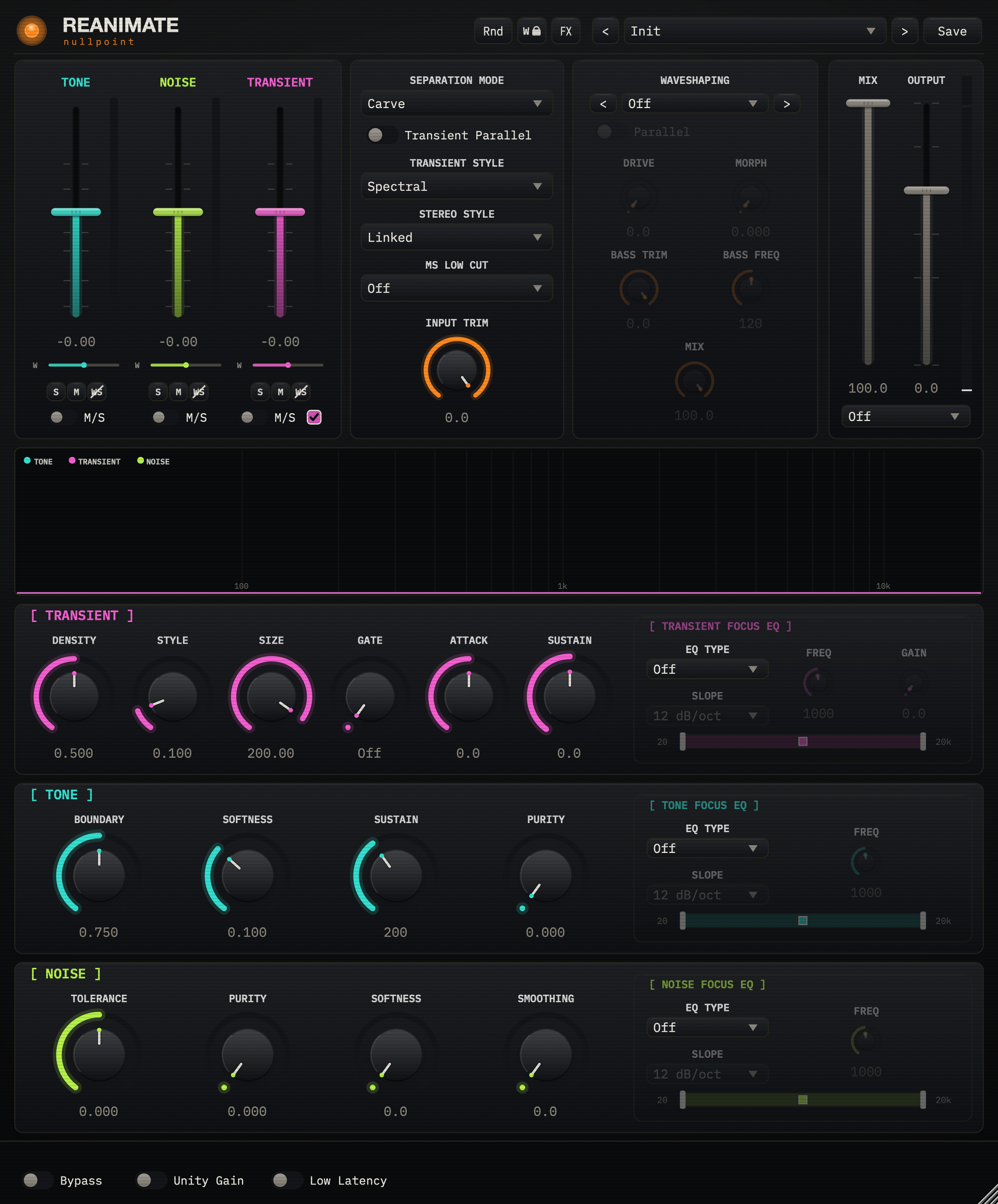
Reanimate decomposes any input into three defined components — tone, noise & transient — each a fully addressable lane. Solo it, reshape it, then recombine bit-exact at unity until you change something.
[ TWO PROMISES ]
01 · TRANSPARENCY
Null at rest.
At default, the output is the input — bit-identical, just latency-delayed. Reanimate never colors your sound until you move something.
02 · INTENT
Transformative by intent.
Pushed hard, the separation and waveshaping turn aggressive on purpose. Artifacts aren't failure here — they're palette.
[ 01 / SIGNAL DECOMPOSITION ]
[ 02 / DUAL-RESOLUTION SPECTRAL ENGINE ]ANALYZER
A dual-resolution spectral engine resolves sustained tone by frequency and catches transient and noise in time. Each component is separated, never filtered, so the three lanes sum bit-exact at unity.
TONESUSTAINED HARMONIC
TRANSIENTVERTICAL ONSET
NOISEBROADBAND RESIDUAL
[ 03 / MIX MODES ]
Carve
SHARED SPECTRUM
The lanes share one spectrum and sum back to the source. Each lane is your isolated hold on one component — lift the transient and only the transient moves; pull a lane down and that component simply steps back from the sum, without leaking into the others. Nothing is redistributed: at unity every lane returns bit-exact, and moving one changes only its own share of the whole. This is the mode for corrective balance: tighten attack, tame residual noise, or shift the tonal weight of a sound while keeping it a single coherent image.
Independent
ISOLATED PATHS
Each lane becomes its own signal path with no shared bus — process, drive and route tone, noise and transient in full isolation, with no interaction between them. Solo a lane to hear it completely alone, or send each to a separate output as stems for parallel processing downstream. This is the mode for sound design and resynthesis: push one lane into destruction without touching the rest, or rebuild a sound from components that never bleed into each other.
[ 03.1 / TECHNICAL ADJUSTMENTS ]MORE TO COME
LOW-LATENCY MODE
A reduced-window path that collapses round-trip delay for tracking and live monitoring — play through the separation in near real time. It trades a little edge off the separation sharpness for responsiveness; switch back to the full-resolution engine for mixdown, where the null and detail matter more than latency.
STEREO / MID-SIDE
Every lane can work in L/R or Mid/Side. Split noise to M-S to widen the air while transients stay locked to the centre, or fold the low tone to mono for a tight, phase-safe bottom end. A per-lane stereo-width control then dials each component in or out — from mono to full spread — so every lane sits at its own width inside one image.
[ 04 / SPECIFICATIONS ]FW 1.0.0
−135dBFS
NULL CONTRACT
Output = input at unity. Verified below −120 dBFS.
~486ms
HQ MODE LATENCY
High-quality path. Constant across every mode, style and control.
~127ms
LOW-LATENCY MODE
Reduced input delay for tracking and live use.
SPECIFICATIONS PROVISIONAL · PRE-RELEASE
[ 06 / GET IT ]